


Introduction
The contemporary market for 3d models for sale encompasses a broad spectrum of applications, from collectible miniatures to functional prototypes. This article provides a rigorous overview of the technical and commercial aspects that informed buyers and enthusiasts should consider when acquiring 3D models and associated printed figurines. The analysis emphasizes specifications, material performance, finishing options, and procurement workflow in order to enable objective comparison and informed decision-making.
Market Context and Buyer Objectives
Demand for purchasable 3d models for sale has diversified with advancements in additive manufacturing and photorealistic scanning. Purchasers typically seek one or more of the following objectives: fidelity to source imagery, dimensional accuracy, durability, surface finish, and ease of integration within a display or functional assembly. High-fidelity figurines that replicate human subjects, pets, or fictional characters require a distinct set of production controls compared with geometric prototypes or automotive maquettes.
Buyer Categories
It is useful to differentiate buyer categories when evaluating offerings: hobbyists and collectors require aesthetic fidelity and paint quality; professional modelers require dimensional accuracy and reliable geometry; product developers prioritize material properties and repeatability. Each category imposes different acceptance criteria on the 3D model and the printed object.
Technical Specifications to Evaluate
When assessing 3d models for sale, purchasers should scrutinize the following technical attributes.
Mesh Quality and Topology
An initial determinant of printability is mesh quality. Models must have manifold geometry, consistent normals, and optimized polygon density to support high-resolution printing. Excessive polygon counts can create unnecessary processing time, whereas insufficient resolution compromises fine detail. Requesting model previews and wireframe images is an industry-standard practice.
Scale and Dimensional Accuracy
Scaled figurines must include explicit dimensions. Common sizes range from 8cm (3.1") to 22cm (8.7"). Ensure that the model's original scale and the seller's scaling conventions are documented. Tolerance specifications should be provided when fitment or assembly with other components is anticipated.
File Formats and Compatibility
Standard file formats for distribution include STL, OBJ, and GLTF. Each format has trade-offs: STL is widely accepted for printing but lacks texture data, whereas OBJ and GLTF retain UV maps and color information needed for hand painted or full-color printing workflows.
Materials and Finishing Options
Material selection is a determinant of mechanical behavior and surface fidelity. Premium resin remains the preferred medium for high-detail figurines due to its fine feature retention and isotropic properties.
Premium Resin Characteristics
Premium resin exhibits fine detail retention, low shrinkage, and excellent surface smoothness. It enables the reproduction of facial micro-details and intricate accessories. When polymerized under controlled conditions, such resins provide consistent color bases for hand painted finishes.
Finishing: Realistic Color vs Hand Painted
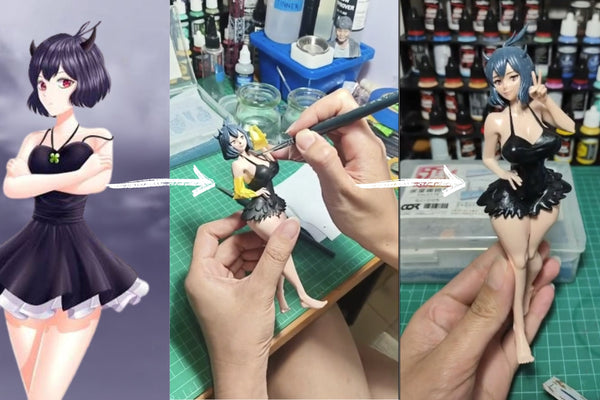
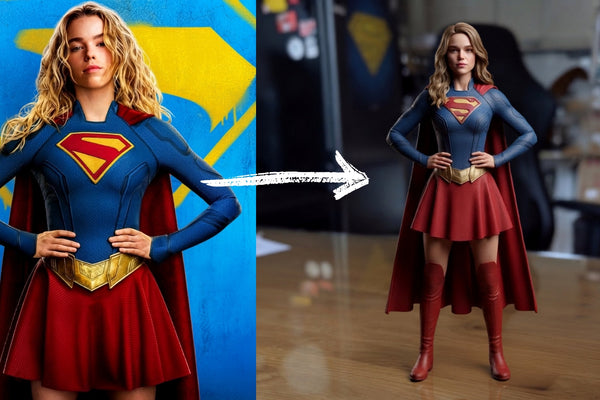
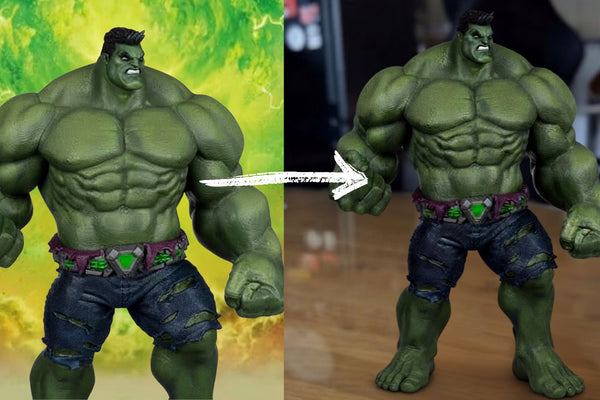
There are two principal finishing categories for collectible figurines: realistic colored 3D printed finishes and hand painted finishes. Realistic colored printing applies full-color textures directly during the print process and is suitable for photographic replication. Hand painted finishes involve skilled application of pigments, offering deliberate stylistic control and subtle surface modulation. The choice depends on whether the priority is photographic fidelity or artisanal appearance.
Customization, Poses, and Outfits
A competitive advantage among suppliers lies in the capacity to deliver custom poses and outfits. Customization requires a controlled workflow for client-provided reference images, model articulation, and preview approvals. Vendors that document an iterative preview process reduce the risk of misalignment between client expectations and final output.
Ordering Workflow and Preview Guarantee
Robust ordering workflows include an explicit preview stage where a digital mockup or rendered image is provided to the client. A practical policy is a 100% refund guarantee if the client does not approve the preview prior to printing. This mitigates downstream waste and supports quality assurance.
Quality Assurance and Reliability
Quality assurance mechanisms should include dimensional inspection, surface validation, and color accuracy checks. Third-party imaging or in-house metrology can be used for verification. Vendors that publish failure rates, reprint policies, and post-delivery support foster greater buyer confidence.
Pricing, Licensing, and Ethical Considerations
Pricing models for 3d models for sale typically combine base fees for digital assets with additional charges for printing, finishing, and shipping. Licensing terms govern permissible use; purchasers should verify whether the purchase confers personal-use rights, commercial rights, or limited redistribution rights. Ethical sourcing of reference imagery and intellectual property clearance for celebrity or copyrighted characters is essential in commercial contexts.
Logistics: Shipping and Geographic Reach
Logistics influence total acquisition cost and lead time. Free delivery policies to key markets reduce transactional friction. For example, vendors that include complimentary shipping to jurisdictions such as the United States, China, Thailand, Singapore, India, and Malaysia simplify the procurement process for international buyers. Confirm expected lead times, tracking options, and customs handling where applicable.
Use Cases and Applications
3d models for sale are employed across domains: collectible figurines, wedding cake toppers, memorial keepsakes, prototype validation, and vehicle replicas. Selection criteria vary by application; collectors emphasize aesthetic fidelity, whereas engineers value material properties and repeatability.
Concluding Recommendations
For purchasers seeking professional-grade outcomes, prioritize sellers that document mesh quality, offer premium resin materials, provide both realistic colored and hand painted finishes, and guarantee pre-print preview approval. Verify file format compatibility and ensure licensing terms align with intended use.
For technical buyers and enthusiasts interested in acquiring custom 3d models for sale or commissioning printed figurines with high-fidelity finishes, consider evaluating suppliers that demonstrate transparent workflows and material specifications. For an exemplar of such a workflow, you may consult Figuro, which provides custom 3D printed figurines across a spectrum of sizes and finishes and offers a 100% preview approval refund policy prior to printing.
Call to action: If you wish to assess specimen work or initiate a custom order, please visit Figuro to start the ordering process or request technical specifications.
Bring Your Best Memories into the 3D World
Tired of looking at your favorite moments through a glass screen? Turn those unforgettable photos into something you can actually touch, hold, and display forever. Whether you're chasing jaw-dropping realism with our Realistic 3D Figurines, adding a fun twist to your desk space with a Custom Bobblehead Figurine, or celebrating a milestone love story with a Personalized Anniversary Couple Gift, we custom-sculpt every single piece to tell your unique story.
👉 Explore Figuro's Full Collection & Start Crafting Yours Today!