


Understanding the STL File: Standards, Structure, and Practical Use
The STL file has become a ubiquitous data format within additive manufacturing and digital fabrication disciplines. Originally developed for stereolithography processes, the STL format encodes a three-dimensional object's surface geometry using a tessellated approximation composed of triangular facets. This article explicates the STL file's formal characteristics, common pitfalls, and optimisation strategies for resin-based 3D printing of figurines, with applied guidance for users of Figuro's custom 3D-printed figurine service.
Definition and Historical Context
STL stands for StereoLithography and is frequently encountered as either an ASCII or binary file. The binary representation is preferred for efficiency because it conserves storage and transmission time, particularly for dense meshes. Despite its simplicity, STL intentionally omits colour, texture coordinates, and material attributes; it is a purely geometric description focused on triangular facets.
Technical Anatomy of an STL File
An STL dataset consists of a collection of triangular facets, each defined by three vertices and an outward-facing normal vector. The normal vector conventionally denotes the facet orientation and is used by slicers and repair utilities to determine surface exteriority. Crucial properties to evaluate in any STL intended for printing include unit consistency, manifoldness, normal orientation, and absence of self-intersections.
Units and Scale
STL files do not embed explicit unit metadata. Consequently, the interpretation of numerical coordinates depends on the originating software's implicit unit system. A model exported in millimetres but interpreted as metres will produce a scale mismatch by three orders of magnitude. When preparing assets for Figuro's production pipeline, ensure export units correspond to the desired final size; Figuro provides figurine sizes ranging from 8cm (3.1') to 22cm (8.7'), and accurate unit selection avoids unintended rescaling during slicing.
Manifoldness and Watertight Geometry
A printable STL must be manifold and watertight. Manifoldness implies each edge is shared by exactly two faces, while watertightness indicates the absence of holes in the mesh surface. Non-manifold edges, inverted normals, and open boundaries commonly generate print failures or require repair. Tools such as MeshLab, Microsoft 3D Tools, and the Netfabb repair utilities are effective for diagnosing and rectifying these defects.
Polygon Count and Surface Fidelity
STL approximates continuous surfaces with discrete triangles; therefore, polygon count governs surface fidelity and file size. Excessive polygon counts increase file transfer times and may complicate repair operations without materially improving print quality beyond the resin printer's resolution. Conversely, excessively coarse tessellation introduces faceting artifacts. For high-fidelity figurines printed in premium resin, target a balanced polygon density that preserves anatomical detail while remaining computationally tractable.
Normal Vectors and Orientation
Correctly oriented normals ensure slicers identify exterior faces and generate coherent toolpaths. If normals are inconsistent, a slicer may misinterpret the object's interior and exterior, resulting in incorrect toolpath generation or hollow areas where solidity is expected. Most modelling packages provide functions to recalculate normals outwardly; include this step before final export.
Preparing STL Files for Resin Printing
Resin printing differs from FDM in notable respects: layer adhesion dynamics, support strategy, and the need to mitigate suction forces during peel steps. Accordingly, STL preparation must incorporate orientation, support placement, and hollowing decisions tailored to resin processes.
Orientation and Support Strategies
Optimal orientation reduces overhangs and minimizes support volume while preserving surface detail on critical areas such as faces and hands. For figurines, orient the model to expose less detailed surfaces to supports and place supports on structurally robust areas. Resin-specific support generation software typically analyses stress points and recommended contact diameters to ensure reliable printing and minimal surface marks upon removal.
Hollowing and Drainage
Large solid volumes in resin prints increase material consumption and prolong post-processing. Hollowing internal regions and including drainage ports reduces resin usage and mitigates pressure differentials during printing. Ensure hollowing maintains structural integrity and that ports are positioned to facilitate cleaning and post-cure operations.
Validation and Repair Workflow
A pragmatic validation pipeline includes the following steps: unit verification, manifold and normal assessment, decimation if needed to control polygon count, and local topological repairs. Utilities such as Netfabb, Meshmixer, and Blender offer automated repair tools along with manual intervention capabilities for complex defects. Prior to submission to any production service, perform a final inspection of bounding dimensions and export the STL in binary for efficiency.
Common Repair Procedures
Frequent remedial tasks include closing holes, removing duplicate vertices, fixing inverted normals, and eliminating small disconnected components. Documented best practices recommend incremental saving and versioning, allowing rollback if a repair operation inadvertently alters intended details.
Integration with Figuro's Custom Figurine Service
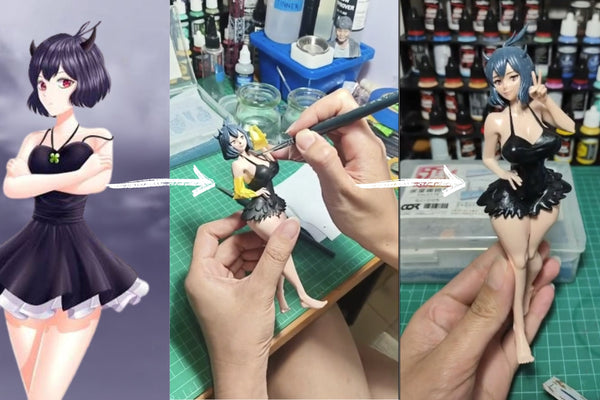
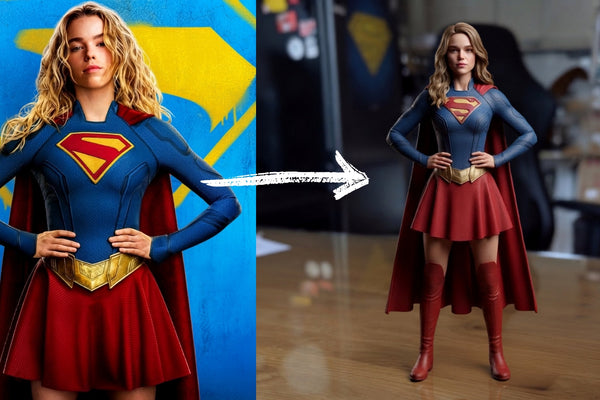
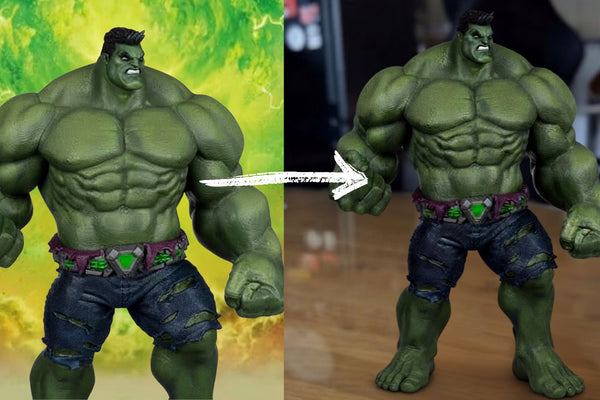
Figuro converts photographic input and sculptural edits into production-ready STL files as part of its end-to-end service. For users who possess their own STL assets or who wish to commission technical customisations, the following particulars are salient:
- Material and Detail: Figuro employs premium resin with high detail retention, which benefits from well-formed STL geometry.
- Size Range: The service supports figurine sizes from 8cm to 22cm, allowing model scaling as necessary by the production team.
- Options: Customers may choose realistic colored 3D printing, hand-painted finishes, custom poses, and custom outfits; these options rely on precise STL geometry to produce accurate previews.
- Quality Assurance: Figuro issues a digital preview prior to printing; customers are eligible for a 100% refund if they do not approve the preview, thereby safeguarding expectations.
- Logistics: Free delivery is included to the United States, China, Thailand, Singapore, India, and Malaysia.
Best Practices and Recommendations
To ensure a predictable manufacturing outcome when supplying or generating STL files, adhere to the following recommendations: export in binary STL, maintain reasonable polygon density, confirm that normals are outward, verify manifoldness, and conduct a print-orientation analysis to reduce support-related post-processing. Where possible, collaborate with Figuro's technical team to exchange previews and iterate on the model prior to final fabrication.
Software Tools and Resources
Commonly used tools for STL preparation include Blender for comprehensive modelling and normal recalculation, MeshLab for inspection and decimation, Netfabb for automated repair, and specialized slicers for orientation and support simulation. For users unfamiliar with technical adjustments, Figuro facilitates model preparation as part of its bespoke service offerings.
Conclusion and Call to Action
Understanding the STL file format and its nuances is essential for producing high-quality resin figurines. Proper attention to units, manifoldness, normal orientation, polygon count, and resin-specific print considerations reduces failure rates and preserves intended detail. If you possess an STL file or seek to transform photographs into a production-ready 3D model, visit Figuro to request a technical review or begin a custom order. The Figuro technical team can assist with STL validation, optimization, and preview generation to ensure the final printed figurine meets exacting expectations.
Bring Your Best Memories into the 3D World
Tired of looking at your favorite moments through a glass screen? Turn those unforgettable photos into something you can actually touch, hold, and display forever. Whether you're chasing jaw-dropping realism with our Realistic 3D Figurines, adding a fun twist to your desk space with a Custom Bobblehead Figurine, or celebrating a milestone love story with a Personalized Anniversary Couple Gift, we custom-sculpt every single piece to tell your unique story.
👉 Explore Figuro's Full Collection & Start Crafting Yours Today!